The Arc Blog

Keep up with all of our programs, events, and activities!

News

Small Moments, Big Impact: 5 Easy Ways to Support Your Child’s Development

Small Moments, Big Impact: 5 Easy Ways to Support Your Child’s Development

The holidays bring more than decorations and family gatherings – they bring extra moments at home, changes in routine, and opportunities for connection. For caregivers of young children with developmental delays, this season can be a meaningful time to slow down, tune in, and support growth in simple, everyday ways.

Amid the wrapping paper, favorite traditions, and cozy routines, children are still learning every day. The way you talk, play, sing, and interact during these moments can help strengthen important developmental skills, often without adding anything new to your to-do list.

When a child shows signs of a developmental delay, caregivers often ask the same question: What can I do right now to help my child?

The answer is simpler than many expect. Some of the most helpful developmental support happens during everyday routines and play.

5 Easy Things You Can Do Every Day to Help Your Child Learn &  Grow

You don’t need special toys, classes, or training. Children learn best when someone is talking with them, playing with them, and responding to them.

1. Talk to your child during everyday routines

Talking helps your child learn how words connect to real life. Even before children can talk back, their brains are listening, matching sounds to actions, and learning that communication has meaning.

For example, while getting your child dressed, you might say, “Shirt on,” or “Arms up,” as you help them move. While making food, you could say, “I’m cutting the apple. Apple is red.” If your child makes a sound, respond to it. If they say “ba,” you can say, “Ba! Bottle.”

When you do this, your child starts to understand that sounds and words go together, and that when they communicate, someone responds. This back-and-forth is how language begins.

2. Look at books together in a relaxed way

Books help children learn words, focus their attention, and understand how pictures and language connect.

Sit together and let your child hold the book. Point to pictures and name them, like “dog,” “car,” or “baby.” If your child points to something, name it for them. If they only want to look at one page or close the book quickly, that’s okay.

Reading the same book again and again is especially helpful because children learn through repetition. Seeing the same pictures and hearing the same words helps their brain recognize patterns. Over time, familiar books make it easier for children to understand, remember, and eventually try words on their own.

3. Play with simple household items

Playing with everyday objects helps your child learn how their hands, eyes, and body work together.

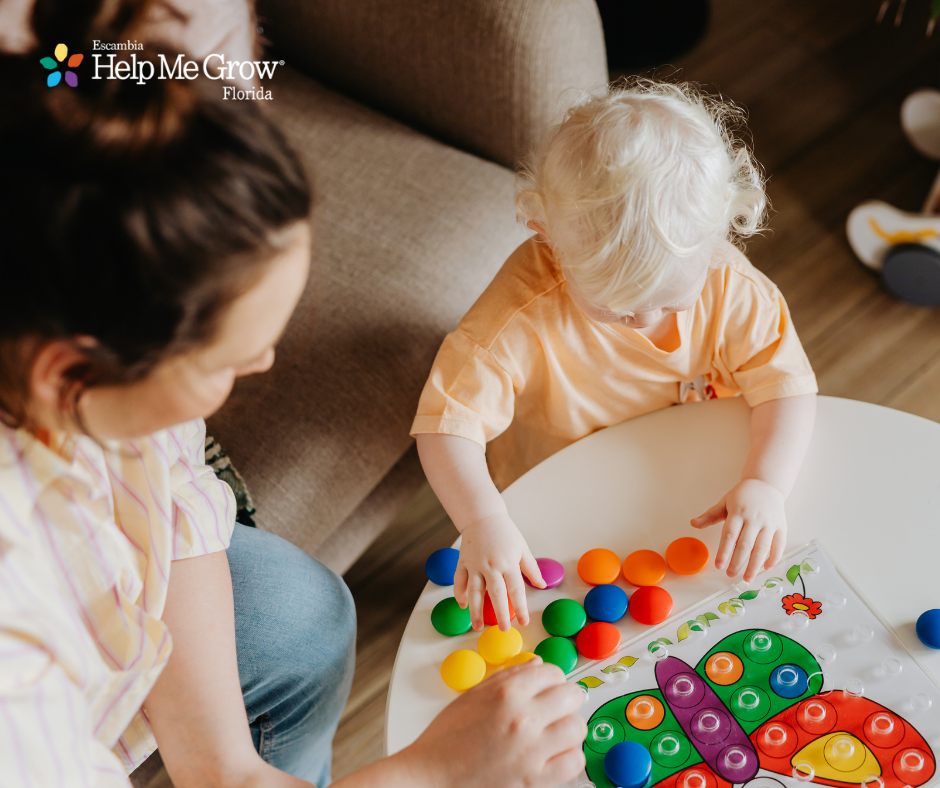
You might stack plastic cups or blocks and knock them over together. You can put toys into a box and dump them out, or let your child try to put a lid on a container or drop items into a bowl.

These activities help children practice using their hands and fingers, figuring out how things fit, and learning that their actions cause things to happen. This builds coordination, problem-solving skills, and confidence, even when play looks messy or unorganized.

4. Sing songs and move together

Songs help children learn language and movement at the same time.

Singing slows words down and repeats them, which makes them easier for children to hear and understand. Adding movements helps children connect words with actions.

You might sing “If You’re Happy and You Know It” and clap your hands, or “The Wheels on the Bus” with motions. You can also turn on music and dance together. Singing the same songs every day helps your child know what to expect and feel more comfortable joining in.

Your child doesn’t need to sing the words. Listening, watching, and moving are all ways they are learning.

5. Take turns during play

Taking turns helps children learn how to interact with other people and begin to understand social rules.

You can roll a ball back and forth and say “my turn” and “your turn.” You can also take turns stacking blocks or putting puzzle pieces in place. If your child doesn’t do it perfectly, that’s okay, the practice is what matters.

Turn-taking teaches children how to wait, watch, and respond. These are important skills for communication, play, and future interactions with other children.

A Supportive Next Step for Caregivers

You are not expected to do everything perfectly. Supporting your child’s development happens in small moments, repeated over time, and you’re already doing more than you may realize.

If you ever find yourself wondering whether your child is meeting developmental milestones, you do not have to wait or figure it out alone. Help Me Grow Escambia offers free developmental screenings to help caregivers better understand how their child is growing.

Screenings are simple and can be completed online, in person or over the phone. If results show that your child may benefit from extra support, Help Me Grow Escambia’s care coordinators will walk you through the next steps and help connect you to services or community resources if needed.

Not every child will need services, but every caregiver deserves clear information, reassurance, and support. That’s why Help Me Grow Escambia encourages caregivers to screen and see, rather than wait and worry.

If you have questions or concerns about your child’s development, Help Me Grow Escambia is here to help.

www.helpmegrowescambia.org | 850-378-0322
RELATED POSTS

Small Moments, Big Impact: 5 Easy Ways to Support Your Child’s Development

The holidays bring more than decorations and family gatherings – they bring extra moments at home, changes in routine, and opportunities for connection. For caregivers of young children with developmental delays, this season can be a meaningful time to slow down, tune in, and support growth in simple, everyday ways.

News

Developmental Specialists: The Unsung Heroes of Early Childhood

When most people think of preparing a child for school and lifelong success, they imagine classrooms, crayons, and ABCs. But readiness starts long before a child ever walks through a school door. It starts in the earliest years of life – through play, connection, communication, and care.

News

5 Sensory-Friendly Fall Crafts for Kids

Fall is the perfect season for cozy, creative fun! For children who may be sensitive to textures, sounds, or overwhelming activities, sensory-friendly crafts offer a way to celebrate the season in a calm and enjoyable way. These activities engage the senses gently while encouraging creativity, fine motor skills, and self-expression.

News

related posts

Sign Up for Our Newsletter

Dawn VonStein

Pollak Training Center Program Manager

A native of Pensacola, Dawn VonStein graduated from the University of West Florida with a bachelor’s degree in early childhood and elementary education.  She began working at The Arc Gateway in 1993 as a support specialist for the Women’s Training Center where she felt she could use her teaching background to help teach daily living skills to the women at the group home. When asked why she has made her career at The Arc Gateway she says it is, “because there are few other places I could work where every day is different, I feel like I’m making a difference in someone’s life, and I am truly loved by those I serve.”

Dondie Roper

PALS Program Director

Dondie is an innovator with more than 15 years’ experience driving results in program management, marketing, and media production. In addition to her studies in Journalism and Communication Arts at the University of West Florida, Dondie has received certification in Nonprofit Management. Dondie is very active in the community serving on board of directors for area nonprofit organizations, secretary/treasurer for UWADA, Loaned Executive with United Way, and volunteer with Special Olympics.

Jennah White

Special Projects Manager

Jennah began her journey with The Arc Gateway in the fall of 2016 as an assistant to Human Resources. During her time with the agency, Jennah has acquired her Bachelor’s Degree in Psychology along with a Certificate in Human Resources both from The University of West Florida.  Jennah can be considered a “jack-of-all-trades” thus securing her role as the Special Projects Manager (Office Manager). She also takes an active role in her community as a member of Pensacola Young Professionals.

Níta J Hooks

Senior Adult Program Manager

Níta started working at the Arc Gateway in January 2019 as the Senior Adult Program Manager. She began working in the Developmental Disabilities field in 2015 as a Support Coordinator and has worked as Supportive Living Coach and a QMRP. Níta earned an Associate Degree in Pre-Nursing, a Bachelor of Science in Psychology, and a Master of Education in Mental Health Counseling. She also worked as a Licensed Clinical Mental Therapist in Mississippi with all populations. “It is a joy to get up each morning, come into the program and work with such a wonderful group of people who keep me on my toes. I wouldn’t trade this job for anything in the world.”

Amanda Holtzhower

Human Resources Manager

Bio 

Rebecca Baron

Residential & Community Service Director

Rebecca is a Pensacola native who graduated from the University of West Florida with a degree in Early Childhood and Elementary Education. She has been a part of The Arc Gateway team for over 2 decades, starting her career with us in 1997. Rebecca’s first position with The Arc Gateway was a Support Specialist in the Pal/Ace program. From that role she became a Group Home Manager with one of our female group homes, then moved into her current position as Director of Residential and Community services. “I love making a difference in the lives of people we serve and assisting them to achieve their goals and gain skills toward independence.”

MaryAnn Bickerstaff

Children’s Services Director

MaryAnn Bickerstaff began her career at The Arc Gateway in 1986 as an Infant Toddler Developmental Specialist soon after completing an internship with the Pearl Nelson Center’s Early Intervention and Preschool programs at the completion of her Bachelor’s Degree in Special Education at the University of West Florida. After working in this role for four years, MaryAnn became the Early Intervention Coordinator and in 1990 assumed the position as Children’s Services Director. During this time, she is proud of the program’s growth and diversity in funding, including grants and fundraising activities, but she is most proud of the impact her team is making in the lives of children every day. MaryAnn is very engaged with community partners and serves on the Board of the Early Learning Coalition and the Operational Support Team of Achieve Escambia among others. MaryAnn is a proud to be a native of Pensacola.

Stephen Rampersad

Chief Advancement Officer

Stephen Rampersad lives in Pace, Florida with his two sons. He’s deeply involved in community advocacy, but cherishes the role of fatherhood above all else. Stephen’s commitment to community engagement shines through various roles such as Chief Advancement Officer at The Arc Gateway, Board President of Hope Above Fear, and Ambassador for the Greater Pensacola Chamber of Commerce. When he’s not busy with his professional responsibilities, Stephen enjoys spending quality time with his family and finding peace in the tranquility of fishing. He values life’s simple pleasures and approaches each day with gratitude.

Larry Love

Chief Financial Officer

Larry Love is an accomplished professional with a diverse background that spans multi-national corporations to locally owned businesses. Growing up in Georgia, Larry attended LaGrange College, where he earned a Bachelor’s degree in Accountancy. After several years in public accounting in Atlanta and determined to further his expertise, Larry pursued a Master of Business Administration at the University of West Florida, graduating in 2010. Over the years, he has honed his skills in accounting, finance, and operations across various industries,

including manufacturing, non-profit organizations, consulting, and hospitality. In addition to his professional endeavors, Larry is committed to community service and currently serves on the Board of Directors for the WSRE-TV Foundation (PBS). He resides in Pensacola with his partner, Schyler, and their adorable Chihuahua mix, Alexis Rose.

Cathy Lauterbach

Chief Operating Officer

Cathy Lauterbach has shared her talent with The Arc Gateway for over two decades. A California native, Cathy obtained a bachelor’s degree in management from St. Mary’s College in Moraga, California. She began her employment with the agency in 1995 as an employment specialist. From that role, she became the program manager at the Pollak Training Center before moving into the position as director of Residential and Community Services, and now her position as COO overseeing adult programs at The Arc Gateway.

Melissa Rogers

Chief Executive Officer

Missy has been working in the field of developmental disabilities since 1997.  Throughout her career she has performed in a variety of roles including direct care, case management, fundraising and administration.  Her extensive knowledge base and experience allows her a unique perspective and understanding of issues facing the disabled community.  Missy’s passion and dedication can be felt in her decision-making process as she always puts the best interests of those being served by the agency first.  In her spare time, she can be seen acting with a local dinner theater acting troupe. Missy holds a Bachelor’s Degree in Psychology from Elon University in North Carolina and is originally from Virginia.